
Transforming Care - history and future
This page includes a summary of the history of Transforming Care, and details of how the CBF has been involved.
Each month, NHS Digital publishes data on the number of children, young people and adults with learning disabilities and/or who are autistic in inpatient units in England. This page sets out key headlines and our analysis of this data.
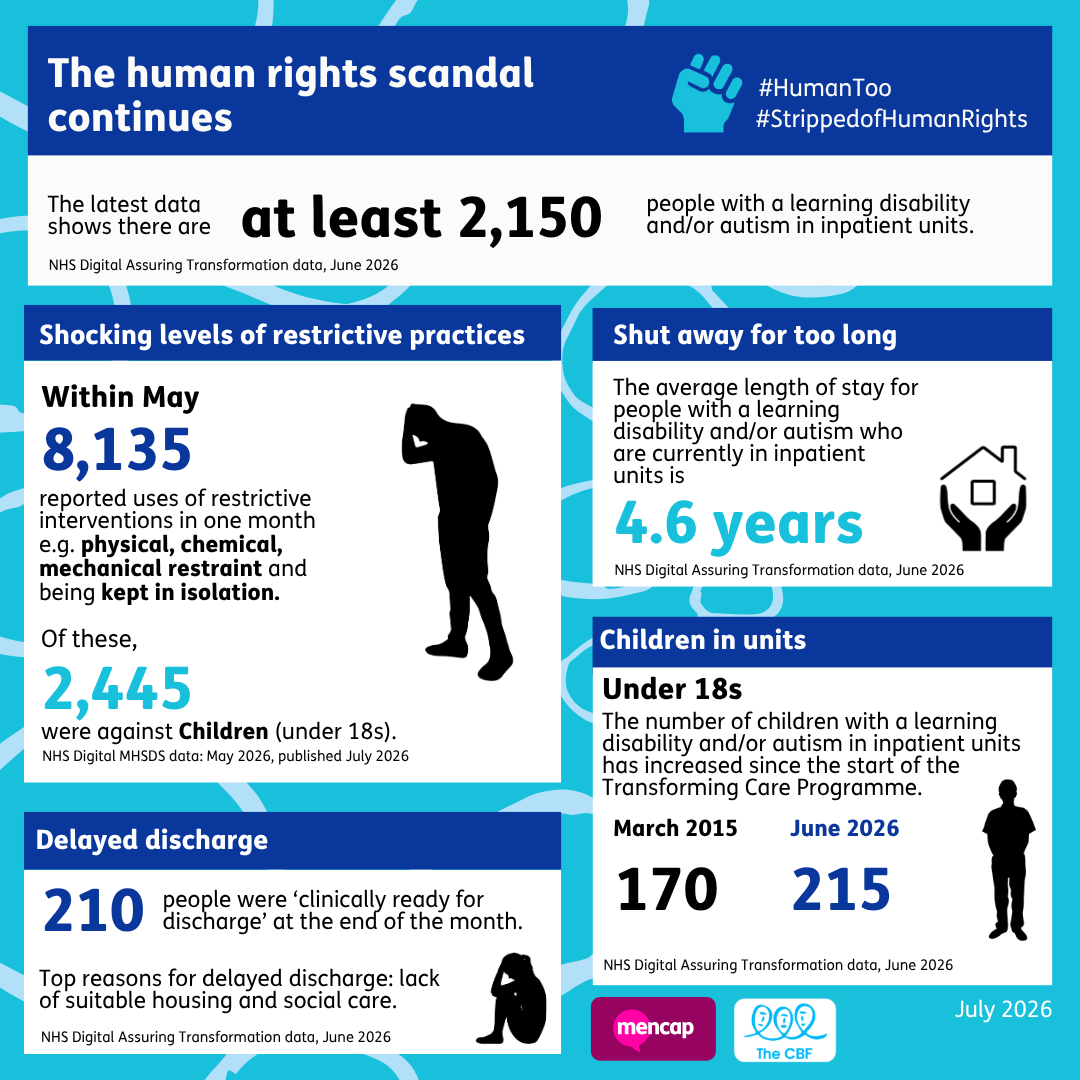
The Assuring Transformation Data Set, which publishes data on people with a learning disability and autistic people in hospital first started being published in March 2015, and the Mental Health Services Data Set began publishing data about restrictive practices used on people with learning disabilities and autistic people in December 2018.
The total number of people with learning disabilities and autistic people in hospital has decreased since March 2015, from 2910 to 2150. The total number of people with learning disabilities, including people with learning disabilities who are also autistic, has also decreased – from 2290 to 915.
Since the last target was missed in March 2024, the total number of inpatients has increased. Analysis by Mencap estimates that, based on the current rate of progress, the target of no more than 30 adult inpatients per million won’t be achieved until May 2036 – over 12 years late.
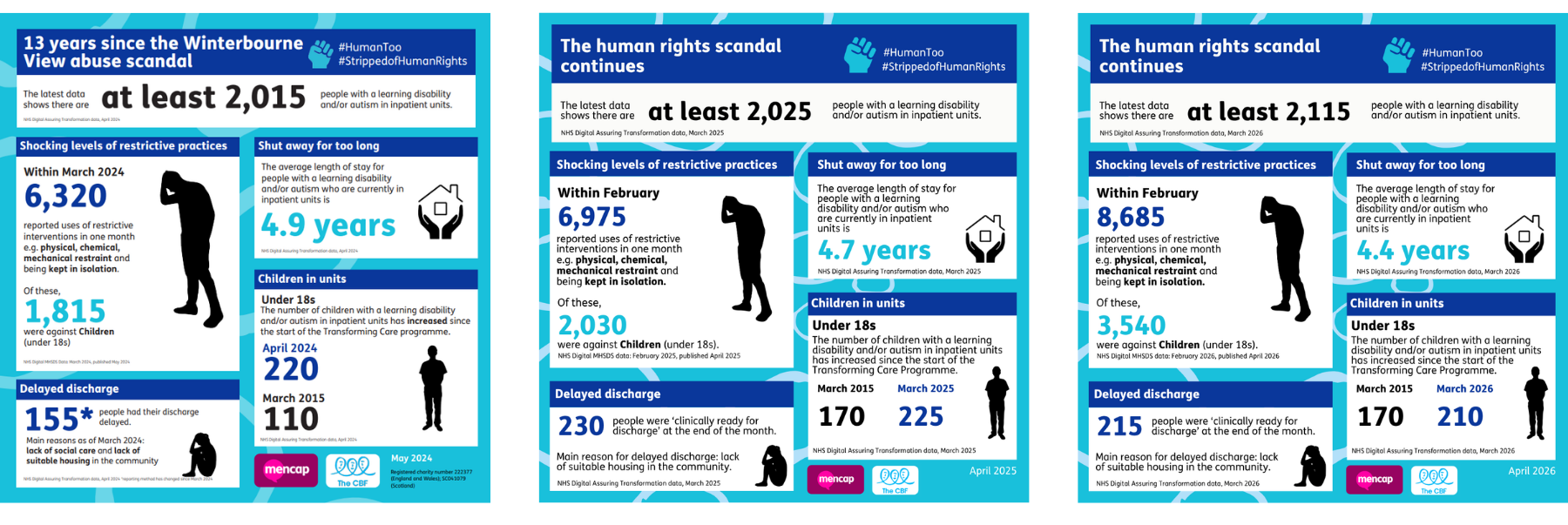 Three infographics covering the statistics from March 2024, March 2025 and March 2026 (published in April or May of each year)
The total number of autistic people who do not have a learning disability has increased by nearly 180% since Assuring Transformation statistics began in March 2015. While the total number of people with learning disabilities in hospital has decreased, 46% of people with a learning disability who are not also autistic have been in hospital for more than 5 years, and 27% have been in hospital for more than 10 years.
People with a learning disability and autistic people are subject to extremely high levels of restrictive interventions in hospital. Restrictive interventions include physical restraint, seclusion, segregation, chemical restraint (use of medication to control behaviour) and mechanical restraint (e.g., strapping someone into a chair to restrict their movement).
In May 2026, 37% of all restrictive interventions used against people in hospital were used against people with a learning disability and autistic people1. Of the 8135 restrictive interventions used against people with a learning disability and autistic people that month, 2445 (30%) were used against children – despite children only making up 5% of the number of people with a learning disability and autistic people in hospital.
Find out more about our work to tackle restrictive interventions
Transforming Care – History and Future
Two datasets are published each month – the Assuring Transformation Data Set (AT), and the Mental Health Services Data Set (MHSDS). Most of the statistics on this page come from the Assuring Transformation Data Set, which specifically looks at people with learning disabilities and autistic people. The statistics on restrictive practices come from the Mental Health Services Data Set. You can access these datasets here: Statistics on people with a learning disability and autistic people in mental health hospitals – NHS England Digital
1 8135/22210 (total restrictive interventions used in May 2026 according to MHSDS Restrictive Interventions Dashboard)
Page last updated: July 2026
Click on the buttons below to see our infographics displaying the data for each month.
This page includes a summary of the history of Transforming Care, and details of how the CBF has been involved.
CBF statement

Information about the Data Group, a subgroup of the Challenging Behaviour - National Strategy Group