
Young people with severe learning disabilities who display behaviours that challenge need lifelong care and support. It is important to avoid sharp cliff edges at the point at which a young person turns 18 or leaves school at 19 years old and stops receiving some of the services that they previously received. Find out more below about how to support positive transitions with the person and their family at the centre of decision making.
New report on transition to adulthood Our open letter to government
Planning for adulthood information pack Transition Podcast
CB-NSG Transition Subgroup Transition Journey Case Studies
What Matters to Me
New report on transition to adulthood
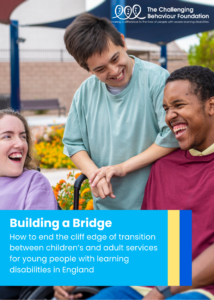 The CBF’s new report, Building a Bridge: How to end the cliff edge of transition between children’s and adult services for young people with learning disabilities in England, brings together family’s experiences with the research that exists about the issues with transition, and what steps can be taken to address these.
The report includes:
- An overview of the legal frameworks and policies around transition
- The issues that young people with learning disabilities and their families face
- Information about the impacts of poor transitions on young people with learning disabilities and their families
- What can be done to make transitions work successfully, including examples from practice demonstrating what works
The report makes five recommendations which are built on what families tell us is important and what the research identifies as issues and solutions. If taken forward these recommendations would make a real difference to the lives of young people with learning disabilities and their families.
Find out more and read the report here
Our open letter to government
 Becoming an adult should be an exciting time for all young people, including young people with a learning disability. However, in reality, young people with learning disabilities face more barriers than their peers, with the move from children’s to adult’s services often described as a “cliff edge.” A lack of coordination results in a complex, confusing and disjointed process for young people and their families to navigate.
We are calling on the government to fix the broken system by:
- Introducing a national, cross-departmental plan for transition
- Introducing a named transition coordinator role for each young person
- Changing the law (Care Act 2014) so that transition planning to adult social care has to begin at age 14.
Click the link below to find out more about our call for action.
You can also watch our short reels featuring family carer, Lina, Jacqui Shurlock, Chief Executive, of The Challenging Behaviour Foundation and Katie Ghose, Chief Executive of KIDS sharing their experiences and explaining why change is needed.
Find out more about our open letter
Planning for adulthood information pack
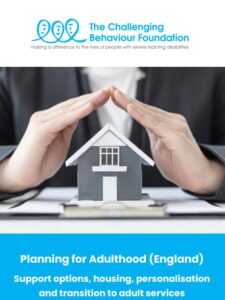
Information packs for families planning their relative’s transition to adult services. The packs are available for England, Wales and Northern Ireland. The pack provides the tools families require as they start to plan for future support and opportunities for their relatives, including education, housing, employment and community involvement.
Challenge Accepted Podcast: Transition Episodes
Join Challenge Accepted’s third series as we take a look at the transition from children’s services to adult services for young people with severe learning disabilities who may display behaviours described as challenging.
Episode 1. Getting to where you want to be – we hear from family carers who’ve been through transition. Where are their relatives now? How did they decide what was best for them? Words of wisdom, witty observations and a whole lot of understanding from those who get it….
Episode 2. So, it IS possible… – our family carers talk about how they secured a home for their relative and what they want you to know if you are on a similar journey. What’s the HOLD scheme? How do you insist on the things you know are important, the non-negotiables? Whether you’re overwhelmed by choices or feel constrained by limited options listen in for real life, real people and real understanding.
Episode 3. Hang on, I didn’t know about that! – real families discuss the importance of connecting with others locally and nationally. With some top tips on how to prepare your young person, their siblings and yourself for some potentially huge changes and how to bond with the people who may be caring for your teenager on a day to day basis if they are moving away from home for the first time.
What Matters to Me
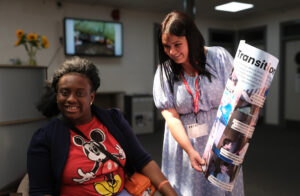 In our What Matters to Me Project, we have been finding out what is important to and for young people with severe or profound and multiple learning disabilities as they transition into adulthood. Based on insights gained through observations and interacting with young people, speaking to families and individuals who know them well, we have created a short film highlighting what matters to young people at transition.
Alongside the film, we’ve also produced a detailed Transition Report, titled ‘Influencing what matters: Transition to Adulthood Findings’, which shares key findings and recommendations.
Find out more about the What Matters to Me Project
CB-NSG Transition Subgroup
The Challenging Behaviour – National Strategy Group (CB-NSG) has formed a transition subgroup to work collaboratively and drive strategic change. The group has identified issues faced by young people with learning disabilities in transitioning from children to adult services, and co-produced the actions that are needed to ensure young people and their families experience a positive transition. These are set out in a co-produced action plan, highlighting the changes needed to start planning earlier and take a co-ordinated approach.
Transition Journey Case Studies
 Family carers have shared their lived experience of transition to adulthood to highlight the systemic change that is needed to improve transition to adulthood for young people with severe learning disabilities and their families.
The transition journey diagrams highlight the cliff edge that is faced by many young people through a failure to plan early and co-ordinate between health, education and social care and highlight what needs to change to ensure that young people with severe learning disabilities, and their families, are fully included, valued and supported during this transitional period.