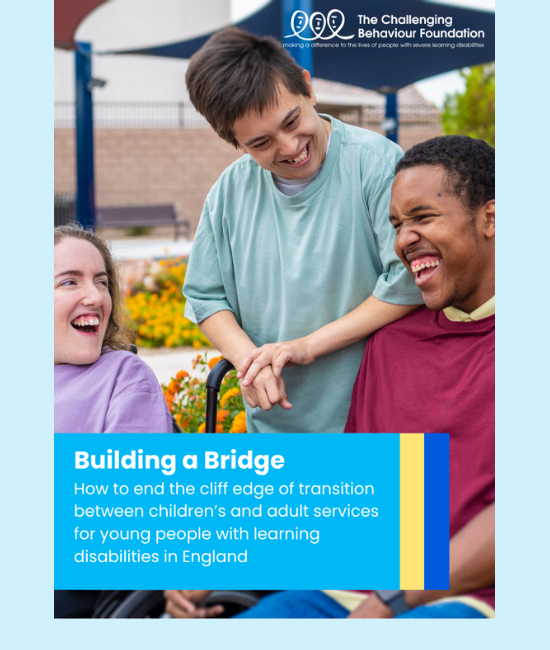
Report Launch – Building a Bridge: How to end the cliff edge of transition between children’s and adult services for young people with learning disabilities in England
Today (2nd July), The CBF are pleased to launch our new report on transition to adulthood
 Transition to adulthood should be a time of opportunity and excitement for young people as they look ahead to their future, but too many young people with a learning disability instead experience a ‘cliff edge’. Despite policies saying that there should be a seamless transition from children’s to adult services with no gaps in support, families supported by the Challenging Behaviour Foundation tell us that they and their relative face complicated and poorly coordinated systems without the right support.
The CBF’s new report, Building a Bridge: How to end the cliff edge of transition between children’s and adult services for young people with learning disabilities in England, brings together families’ experiences with the research that exists about the issues with transition, and what steps can be taken to address these.
Young people with a learning disability don’t transition to a service, they transition to a life. The services should be there, at the right time, to support their transition; ending the predominately poor transition experience, and bringing everyone involved on the same page and thinking about what really needs to happen.
— Oana, family carer
The report includes:
- An overview of the legal frameworks and policies around transition
- The issues that young people with learning disabilities and their families face
- Information about the impacts of poor transitions on young people with learning disabilities and their families
- What can be done to make transitions work successfully, including examples from practice demonstrating what works
The report makes five recommendations:
- Improve joint working by introducing a national, cross-departmental plan for transition, co-produced by young people with learning disabilities and their families
- Make sure all young people and their families have access to a named transition coordinator
- Introduce a statutory age of 14 to begin transition planning
- Strengthen the evidence base for ‘what works’ in transition for young people with learning disabilities
- Address the increased inequalities faced by young people with learning disabilities from minoritised ethnic groups
If taken forward, these recommendations, which are built on what families tell us is important and what the research identifies as issues and solutions, would make a real difference to the lives of young people with learning disabilities and their families.
Jacqui Shurlock, CEO of the Challenging Behaviour Foundation, said:
Becoming an adult should be a time of growing independence and opportunities, and for young people with learning disabilities and their families, this should be no different. Yet, too often, as young people move into adulthood, essential opportunities and support fall away. Established routines are disrupted, trusted relationships are lost, needs go unmet, and rights that should be upheld are too often overlooked, and family carers are frequently left to step in and fill the gaps.
This should not be the experience of turning 18. Adulthood should never come as a surprise. We must do better.
This report identifies the systemic problems that create the “cliff edge” and considers how to build the bridges to prevent it. With the right planning, support, and accountability, young people can access the opportunities they are entitled to—and families can be families, not substitutes for the state.
Polly Somervell, Family Carer and Co-Chair of the Challenging Behaviour – National Strategy Group Transition Subgroup, said:
As a family carer of young people with learning disabilities, the transition from childhood into adulthood can be an incredibly confusing and daunting process. With so many parts of the system changing at once, it can feel overwhelming and difficult to navigate.
This is such an important point in young people’s journeys, shaping what the rest of their life will look like. We need services to work together in partnership, with the family placed firmly at the centre, to make it a success for them.
As families, we know our relatives best and know what they need. However, too often we are not listened to, or the right kind of support does not exist. Like any family, we want our loved ones to have fulfilling, happy, and independent lives as they move into adulthood— but we have to fight so much harder to achieve this.
 We would like to thank Paul Hamlyn Foundation for funding The Challenging Behaviour Foundation’s work on transition to adulthood, which has made this report possible. The views in this report are those of the authors and not of Paul Hamlyn Foundation.
We would also like to thank everyone who contributed to this report and those who acted as external reviewers.
Further information
The CBF has produced a range of resources relating to transition to adulthood, which you can find here:
Transition to Adulthood – Challenging Behaviour Foundation
Learn more about the work of the CB-NSG Transition Subgroup and how to get involved in our influencing work around transition here:
Transition Subgroup – Challenging Behaviour Foundation
You can follow us on social media to see and share our posts on the report: