
Whitefield School: Safeguarding Practice Review Published
In response to the publication of the Safeguarding Practice Review concerning Whitefield School, the CBF highlights the need for the misuse of restrictive practices to be recognised as a child protection issue and for the practice of seclusion to be banned in schools.
Waltham Forest has published its Local Child Safeguarding Practice Review, Learning from the past: The use of restrictive practices, including seclusion, in a school for children with additional needs.
Background
Please be aware that some of the content of this statement may be distressing. If you are a family carer and have been affected by any of the issues raised in this statement, please contact the CBF’s Family Support Service – further details and resources can be found at the bottom of this statement.
In November 2024, BBC Panorama broadcast ‘The School Prison Cells’, showing autistic children and children with learning disabilities being abused and neglected in a seclusion room in a special needs school in London between 2014 and 2017.
Following the broadcast of the programme, which exposed serious safeguarding failures at Whitefield School in the London Borough of Waltham Forest, the local authority instigated a safeguarding practice review.
Local Child Safeguarding Practice Review
Focusing primarily on the use of designated “calming rooms” during a three-year period, the review finds that these rooms were used for seclusion in response to behaviours that challenge, and that this represented a “significant safeguarding failure” which raised serious concerns regarding “the ability of the staff, leadership and governance of the school to recognise and respond appropriately to harmful practice”.
Importantly, the review highlights the stark contrast between the children’s experiences and the limited awareness among families and partner agencies of the traumatic practices.
Until an Ofsted inspection in 2017, concerns were continually dismissed or were not appropriately escalated. Instead, a “culture of desensitisation” and normalisation of restrictive practices was fostered among staff, along with a closed institutional environment. Weak school leadership and oversight, a failure to follow internal policy and insufficient transparency with wider safeguarding agencies resulted in poor visibility and scrutiny of the use of restrictive practices at the school.
In response to the review, CBF Chief Executive Jacqui Shurlock commented:
“Our thoughts are with the 38 children and young people who experienced significant harm at Whitefield School, and with their families, who have been forced to fight for answers and accountability over a significant period of time.
It is clear from the review that the term “calming rooms” was a euphemism — there was no therapeutic purpose to the rooms and, instead, the children and young people were regularly secluded in a padded room for lengthy periods with no access to food or toilet facilities. The review found that the practices were neglectful, emotionally and physically harmful, and were able to continue undetected over a significant period of time.
It is shocking that this review only happened due to the bravery of the families of the children and young people in speaking out to BBC Panorama. The system failed to detect or act on systemic safeguarding failures. To date, no one has been held accountable for gross safeguarding failures against multiple vulnerable children and young people.
Young people with a severe learning disability, many of whom are unable to express their needs verbally, have a right to protection, safety and dignity at school. Although this review focuses on events that happened some time ago, the current national picture is that seclusion is still permitted in schools in England.
The use of seclusion is an outdated and harmful way of responding to behaviours that challenge shown by disabled children. The Department for Education should reflect on this review and take action to ban the use of seclusion in schools in favour of evidence-based approaches, and strengthen safeguarding & oversight responses to the misuse of restrictive practices. Failing to act will lead to further avoidable harm to disabled children and their families.”
The review found that information available at the time was viewed primarily through a regulatory and school improvement lens. It is essential that the misuse of restrictive practices is viewed as a child protection issue, and that the potential for long-lasting harm is recognised appropriately. Effective oversight is needed to move beyond compliance, identify emerging patterns of concern and prevent harm.
The CBF, along with 30 other charities from across the UK, continues to call for governments across the UK to take steps to implement safeguards to protect disabled children and young people from harm caused by the misuse of restrictive practices. We call for:
- Seclusion to be banned. This practice is outdated, inhumane and unsafe. A national programme of action is needed to oversee the safe elimination of seclusion in each UK nation.
- Stronger safeguarding for children and young people, including:
- The recognition of organisational abuse and closed cultures,
- School data on the use of restraint and restrictive practices to be shared with local safeguarding partnerships to ensure this is viewed through a safeguarding perspective.
- Training for social workers in restrictive practices to enable better identification of the harmful use of restrictive practices and enable suitable safeguarding responses.
- Legislation that gives staff the power to use force to “maintain good order and discipline” in schools to be repealed.
- National minimum training standards, including on therapeutic ways of responding to behaviours that challenge including PBS, trauma-informed practice and attachment-based practice.
Leigh Day Solicitors are representing 10 of the families affected, have also published a statement on this Safeguarding Practice Review: Leigh Day represents families in Whitefield School claims
Alison Millar, partner at Leigh Day who is leading the civil case, said:
“The children and families we represent have endured the consequences of a regime of isolation at Whitefield School that should never have been allowed to happen. What was done to these children was profoundly harmful, and its impact continues to be felt by families every day.
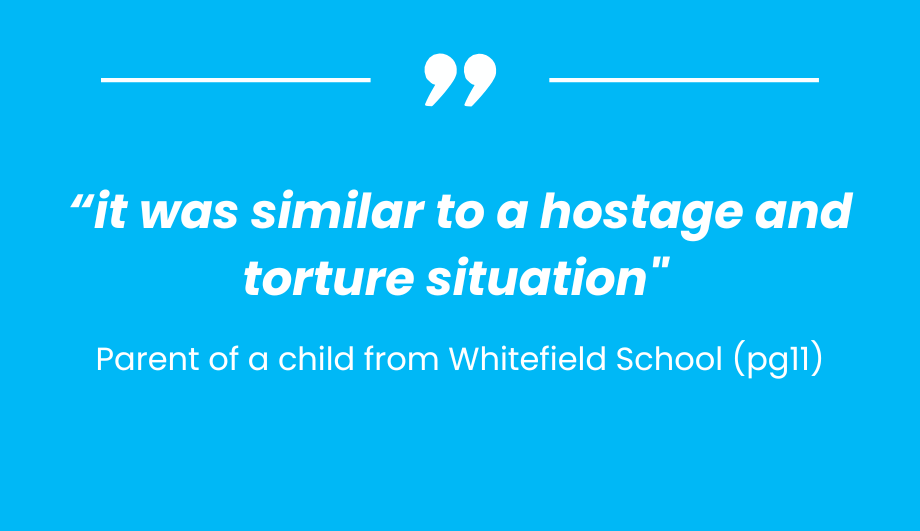
The review confirms that there was no justification for the restrictive practices in operation at Whitefield School between 2014 and 2017. It also highlights that many of the children could not understand why they were being put in these rooms or what they could do to get out of them; for children with autism, learning disabilities and communication difficulties, the experience would often have been incomprehensible, as well as frightening. The use of the so-called calming rooms against children with multiple vulnerabilities was, in our clients’ view, nothing short of torture.
Leigh Day is now representing 10 clients in civil claims against Flourish Learning Trust and the London Borough of Waltham Forest. The claims include allegations that the use of the rooms was inconsistent with the school’s duty of care, amounted to false imprisonment and breached our clients’ human rights. The use of forcible isolation in a locked room against a child is in our clients’ view, barbaric, and we believe wholly inconsistent with the school’s duty of care towards our clients and represented a serious breach of their human rights.
Our clients are seeking accountability and redress for the harm these practices caused.”
For further information, please see:
CBF statement on restrictive practices
Family Support Service
If you have been affected by any of the issues raised in this statement, you can call the Family Support Service on 0300 666 0126
Or email us at support@thecbf.org.uk
We are open at the following times:
Monday – Thursday: 9am – 5pm | Friday: 9am – 3pm
We can provide information and support about the needs of your relative with a severe learning disability whose behaviour may be described as challenging. We can also help you navigate the complex health, education, and social care systems.
Please note we are a small support service so you may not be able to get support straight away. We will support families with urgent concerns as a priority.
Professionals are also welcome to contact the CBF.